The open source AI
research agent

Reads papers, searches the web, writes research drafts, plans experiments, and cites research claims. Use it from the terminal or open the local science workbench for chat, artifacts, notebooks, compute, and provenance.

Made by Companion

GitHub

Use curl for the bundled runtime, or npm if you already manage Node locally.

Need just the skills? Install the skills-only bundle.
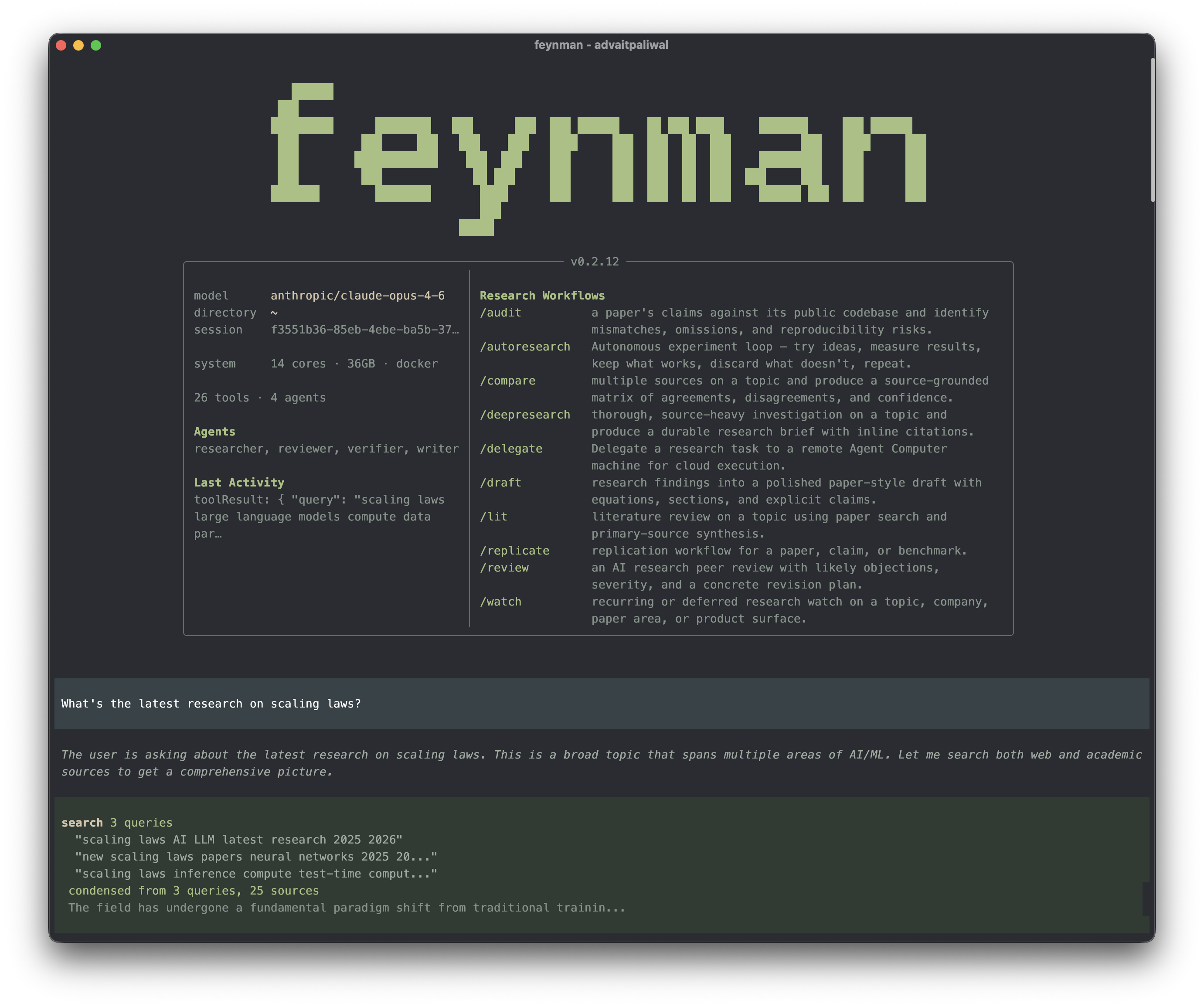
Feynman CLI

Local science workbench

`feynman serve` opens a standalone Feynman app for research runs that need chat, files, tools, notebooks, and audit trails in one place.

Project control plane
Projects, sessions, frame records, upload-frame links, frame health records, onboarding context, and specialist selection stay in Feynman's workspace state
Pi chat and tools
Chat runs through local Pi sessions with frame rows, frame message rows, transcripts, tool activity, attachments, and command insertion
Science artifacts
Reports, data files, media, spreadsheets, notebooks, LaTeX, chemistry sketches, structures, genomes, previews, versions, lineage, execution logs, and verification checks are browsable together
Feynman-owned setup
Bio connectors, frame records, frame message records, frame health records, watch routine records, skill source/license records, setup decision records, review feedback records, compute poller leases, memory categories, permissions, compute providers, and redacted credential availability do not depend on another local app

What you type → what happens

Ask a research question or run a workflow. Research claims carry citations.

feynman "what do we know about scaling laws" Cited research brief from papers and web
feynman rank "sparse autoencoders" PaperRank table with citation, graph, methodology, and reproducibility scores
feynman serve Local science workbench with Pi chat, Bio Tools, notebooks, compute, artifacts, provenance, skills, and settings
feynman deepresearch "mechanistic interpretability" Multi-agent deep dive with synthesis and verification
feynman lit "RLHF alternatives" Literature review with consensus and open questions
feynman audit 2401.12345 Paper claims vs. what the code actually does
feynman replicate "chain-of-thought improves math" Replication plan, compute target, gated experiment steps
feynman recipe "fine-tune a small model for math reasoning" Ranked, implementable ML training recipes

Workflows

Slash commands or natural language. Your call.

/deepresearch
Multi-agent investigation across papers, web, and code
rank
PaperRank scoring for what to read first, with graph and methodology evidence
/lit
Literature review from primary sources with consensus mapping
/review
Internal research critique with severity scores and a revision plan
/audit
Paper-to-code mismatch audit for reproducibility claims
/replicate
Replication plan with environment choice before any execution
/recipe
Ranked ML training recipes grounded in papers, datasets, docs, and code
/compare
Side-by-side source comparison with agreement and conflict matrix
/draft
Polished paper-style draft with inline citations from findings
/autoresearch
Bounded loop: hypothesize, experiment, measure, repeat
/watch
Research watch baseline with optional scheduled follow-up

Agents

Specialist agents join when the research task needs them.

Researcher
Hunts for evidence across papers, the web, repos, and docs
Reviewer
Grades claims by severity, flags gaps, and suggests revisions
Writer
Structures notes into briefs, drafts, and paper-style output
Verifier
Checks citations, verifies URLs, removes dead links

Skills & Tools

How Feynman retrieves sources, preserves research continuity, and renders artifacts.

Feynman Bio Tools
Open science connectors for literature, PubMed metadata, ID conversion, related articles, citation matching, copyright checks, PMC full-text routing, bioRxiv/medRxiv preprint windows, DOI lookup, published links, funder/ROR lookup, preprint statistics, Europe PMC open-access full-text sections, citation graphs, authors, venues, OA status, ClinicalTrials.gov trial details, sponsors, eligibility, investigators, endpoints, Grants.gov opportunities, FDA labels, adverse events, recalls, Drugs@FDA applications, application counts, pharmacologic classes, generic equivalents, ChEMBL compounds, drug indications, ADMET properties, bioactivity, mechanisms, targets, genes, BioMart, CellGuide, PanglaoDB marker genes and gene-to-cell-type lookup, Antibody Registry RRIDs and catalog lookups, reagents, cell types, metabolomics, genome tracks, exact ENCODE/JASPAR/UniBind regulation workflows, UniBind TF-DNA binding, exact gnomAD/CADD/ClinVar/dbSNP variant workflows, GTEx expression and eQTL workflows, KEGG cross-links and ID conversions, InterPro/Pfam protein domains, Rfam RNA family models and sequence search, ArrayExpress/GEO/MetaboLights/MGnify/PRIDE archive project, sample, file, analysis, and protein-evidence workflows, Human Protein Atlas records, STRING networks and homology, purchasable ZINC compounds, GWAS, eQTLs, proteins, predicted structures, EM maps, complexes, interactions, omics, chemistry, pathways, and canceromics
Paper search, Q&A, code reading, and annotations via the alpha CLI
Hugging Face Hub
Dataset schema, repo file, and small text-file inspection
Web search
Searches via Exa, Perplexity, or Gemini API
Session search
Indexed recall across prior research sessions
Preview
Local viewers for reports, PDFs, media, spreadsheets, notebooks, LaTeX, KET/RXN/CDXML/CXSMILES chemistry, structures, genomes, alignments, trees, and tensors

Compute

Optional execution targets for research experiments after the workflow chooses an environment.

Isolated containers for explicitly chosen replication and benchmark runs
Burst GPU execution for bounded research benchmark jobs
Persistent GPU pods for long-running research experiments with SSH

Built on Pi and alphaXiv. Capabilities ship as Pi skills and research outputs stay source-grounded.